

YES, i do believe in minimalism in my personal & professional life.
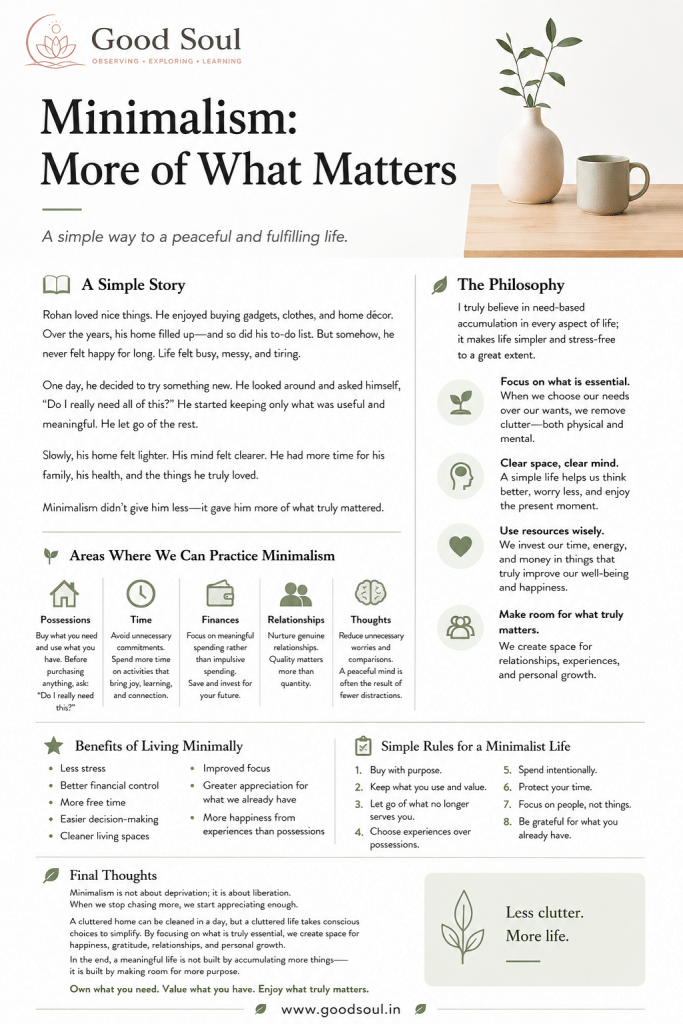
Minimalism: Living with Less, Living with More
A Simple Story
There once lived a man who spent his entire life collecting things.
Every year he bought new clothes, gadgets, furniture, and decorations. His house became bigger, but so did his worries. He spent his weekends organizing, cleaning, repairing, and managing his possessions.
One day, he visited an old friend who lived in a small home. The friend owned only what he truly needed. His house was neat, his mind was calm, and he always had time for family, friends, and hobbies.
Curious, the man asked, “How can you be so happy with so little?”
The friend smiled and replied,
“I do not own less because I cannot own more. I own less because I need less. When I stopped filling my life with things, I found space for what really matters.”
That simple conversation changed the man’s life forever.
What is Minimalism?
Minimalism is not about living with nothing.
It is about living with enough.
It is the practice of keeping only what adds value to our life and letting go of what does not. It encourages us to focus on needs rather than endless wants.
Minimalism is not a sacrifice. It is a conscious choice to make life simpler, lighter, and more meaningful.
The Philosophy Behind Minimalism
I strongly believe in need-based accumulation in every aspect of life.
When we collect only what we truly need, life becomes simpler and less stressful. We reduce physical clutter, mental distractions, and unnecessary responsibilities.
The goal is not to own fewer things just for the sake of it. The goal is to create more room for:
- Peace of mind
- Meaningful relationships
- Better health
- Valuable experiences
- Personal growth
- Financial stability
- Happiness in the present moment
Minimalism teaches us an important lesson:
The value of life is not measured by how much we own, but by how well we live.
Areas Where We Can Practice Minimalism
1. Possessions
Buy what you need and use what you have.
Before purchasing anything, ask:
“Do I really need this?”
2. Time
Avoid unnecessary commitments.
Spend more time on activities that bring joy, learning, and connection.
3. Finances
Focus on meaningful spending rather than impulsive spending.
Save and invest for your future instead of collecting things that quickly lose value.
4. Relationships
Nurture genuine relationships.
Quality matters more than quantity.
5. Thoughts
Reduce unnecessary worries and comparisons.
A peaceful mind is often the result of fewer distractions.
Benefits of Living Minimally
- Less stress
- Better financial control
- More free time
- Easier decision-making
- Cleaner living spaces
- Improved focus
- Greater appreciation for what we already have
- More happiness from experiences than possessions
Simple Rules for a Minimalist Life
- Buy with purpose.
- Keep what you use and value.
- Let go of what no longer serves you.
- Choose experiences over possessions.
- Spend intentionally.
- Protect your time.
- Focus on people, not things.
- Be grateful for what you already have.
Final Thoughts
Minimalism is not about deprivation; it is about liberation.
When we stop chasing more, we start appreciating enough.
A cluttered home can be cleaned in a day, but a cluttered life takes conscious choices to simplify. By focusing on what is truly essential, we create space for happiness, gratitude, relationships, and personal growth.
In the end, a meaningful life is not built by accumulating more things—it is built by making room for more purpose.
Own what you need. Value what you have. Enjoy what truly matters.
This version is intentionally simple, easy to read, and suitable for readers of all age groups. It can work well as a website blog, newsletter article, LinkedIn post, or community magazine feature.